Resonance vs. Innocence and Requiem: The Complete Series Evolution
Discover how Resonance: A Plague Tale Legacy evolves the franchise. We compare combat, light mechanics, and the Macula across all three games before the August 27 launch.
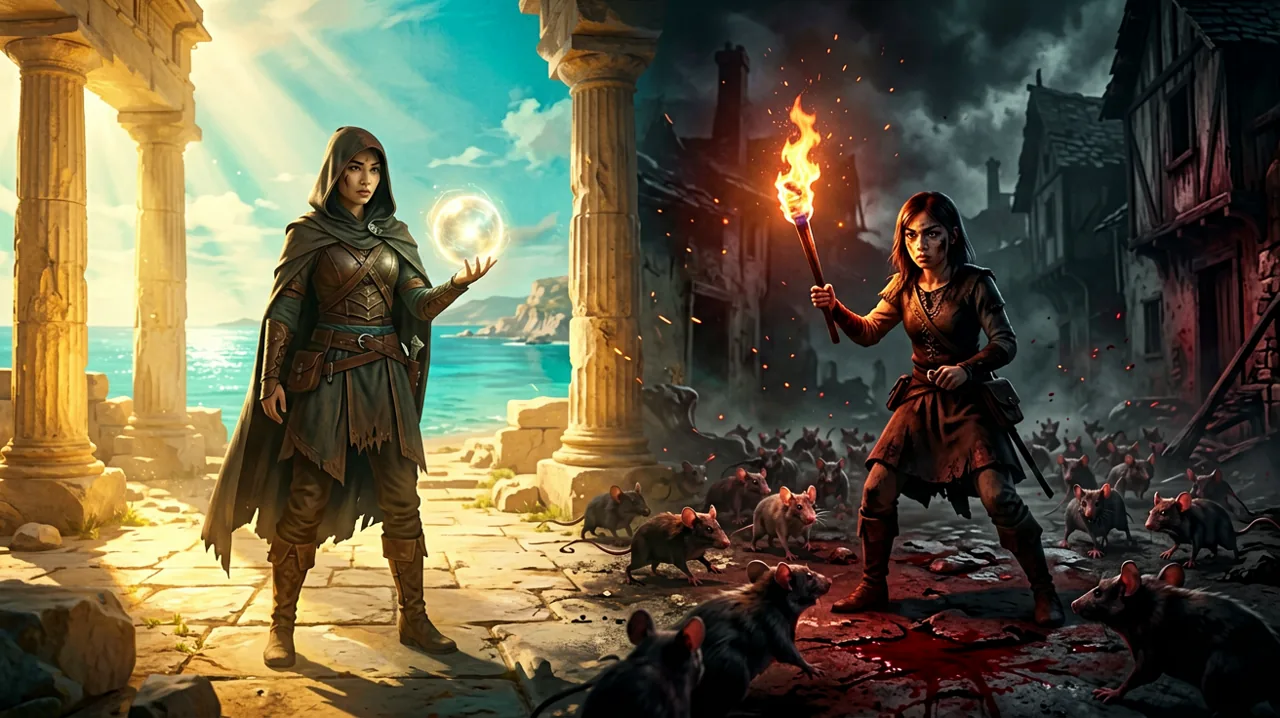
With the impending launch of Resonance: A Plague Tale Legacy on August 27, Asobo Studio and Focus Entertainment are ramping up their final promotional push. The recent release of the “Look For The Light” trailer via GameStop has reignited a central question among the community: exactly how does this prequel stack up against its predecessors?
As highlighted by recent media coverage mapping out complete series comparisons, the shift from 14th-century France to the sun-drenched, myth-soaked island of Crete is far more than a simple change of scenery. Resonance fundamentally overhauls the core pillars established in A Plague Tale: Innocence (2019) and A Plague Tale: Requiem (2022).
For players consulting our story primer and preparing to face the shadows, understanding this mechanical and narrative evolution is crucial. Here is the definitive breakdown of how Resonance: A Plague Tale Legacy transforms the franchise from a desperate sibling escort mission into a brutal, timeline-bending survival action experience.
Protagonists: From Protective Sibling to Hardened Smuggler
The most immediate departure in Resonance is its protagonist. For two entire games, players experienced the horrors of the Black Death through the eyes of Amicia de Rune. Amicia’s character arc was defined by her reactive descent into violence; she was a noble-born teenager forced to shed her innocence to protect her cursed younger brother, Hugo. Her motivations were intimately tied to family, making her journey deeply emotional but fundamentally defensive.
Enter Sophia. Set in 1334—roughly 15 years before the events of Requiem—Resonance places players in the boots of a pragmatic, world-weary Venetian smuggler. Sophia is not a terrified child reacting to a sudden apocalyptic event. She is a capable rogue who intentionally travels to the Minotaur’s island in pursuit of truth surrounding the Prima Macula.
While she shares character dynamics with NPCs like Leni, Sophia’s narrative framework is largely solitary and proactive. She is an archetype of independence. This shift allows Asobo Studio to craft a protagonist who approaches danger not with frantic desperation, but with calculated lethality. You can learn more about how her background influences the narrative in our deep dive on how Venice and Crete shape her journey.
The Setting: 1348 France vs. 1334 Crete
Innocence and Requiem masterfully utilized the grim, plague-devastated landscapes of medieval France (and briefly Provence). The environments were heavily grounded in historical misery—muddy battlefields, corpse-filled aqueducts, and quarantined villages under the iron fist of the Inquisition. The color palette heavily favored drab greys, sickly greens, and the terrifying crimson of the rat swarms.
Resonance rewrites the aesthetic rulebook. By moving the timeline back to 1334, before the massive outbreak seen in Innocence, the game introduces players to the vibrant, historically rich environment of Crete and the ruins of Knossos. The Aegean setting offers a striking contrast to the horrors lurking beneath. Asobo Studio expects to leverage dual eras through the new Resonance mechanic, allowing players to view these ruins both in their decayed 14th-century state and their golden, ancient Minoan glory.
Combat Evolution: Slingshots to Swordplay
If there is one aspect where Resonance most aggressively distances itself from the mainline entries, it is the combat loop.
Amicia’s combat was famously ranged and stealth-dependent. Armed primarily with a David-and-Goliath style slingshot (and later a crossbow), Amicia was incredibly vulnerable in melee encounters. If a guard closed the distance in Innocence, it resulted in an instant death animation. Requiem introduced counter-attacks, but Amicia remained a ranged fighter at heart.
Because Sophia is an experienced smuggler, the developers have implemented a fully fleshed-out melee combat system. Previews and the recent combat deep dive indicate that players will engage in one-versus-many sword fights, utilizing a robust parry and execution system.
Sophia is highly athletic, capable of closing gaps and managing crowd control in ways Amicia never could. Furthermore, the introduction of a grappling hook replaces the slingshot as the primary tool for environmental navigation and dynamic takedowns, creating a faster, far more aggressive gameplay loop that leans heavily into action-adventure territory.
The Light Mechanics: Alchemy vs. The Minoan Orbs
“Hope shines through the darkness,” states the recent GameStop trailer. “When cornered by the shadows, always look for the light.”
Light has always been the primary weapon and shield in the A Plague Tale universe. In previous titles, Amicia relied on alchemy—crafting Ignifer to light braziers and Odoris to attract rats. Managing resources to create localized pockets of fire was the core puzzle-solving mechanic to navigate the rat tides.
Resonance evolves this concept dramatically through the introduction of Minoan Light Orbs. Instead of merely throwing alchemical pots at torches, Sophia can steal and manipulate these ancient, glowing orbs. As detailed in our light puzzles guide, these orbs are not just sources of illumination; they are tied to the island’s ancient technology and the dual-timeline mechanic.
By utilizing the orbs, Sophia can interact with the environment across different eras, altering the architecture of the labyrinth to solve complex spatial puzzles. It transitions the series’ puzzle-solving from resource-management survival to cerebral, environmental manipulation.
The Enemy: The Rat Swarms vs. The Ancient Presence
The antagonist of the original duology was twofold: the oppressive human factions (the Inquisition and the Order) and the literal tsunami of plague rats driven by the Prima Macula in Hugo’s blood. The rats acted as an environmental hazard, a liquid-like entity that devoured everything outside the light.
As a prequel exploring the origins of the curse, Resonance introduces a different manifestation of the Macula. While the exact nature of the threat remains shrouded in mystery, developer updates and community analysis suggest that players will be hunted by an ancient “Presence” within the labyrinth.
This implies a shift from managing thousands of mindless swarming creatures to engaging in high-stakes stealth and survival against a more calculated, perhaps singular, mythological threat that predates the European outbreak. The shadows in the deep dark places of Crete hide something older and potentially more sinister than the rats of Guyenne.
Looking Ahead to August 27
While Innocence and Requiem stand as modern masterpieces of narrative-driven stealth, Resonance: A Plague Tale Legacy is shaping up to be a mechanical revolution for the franchise. By swapping defensive ranged combat for aggressive melee, replacing alchemical fire with time-bending Minoan artifacts, and trading the bleakness of plague-torn France for the mythological depths of the Aegean, Asobo Studio is taking a massive, calculated risk.
The game officially launches on August 27 across PlayStation 5, Xbox Series X|S, and PC (via Steam and the Epic Games Store). For those subscribed to the Microsoft ecosystem, it has been confirmed as a Day One release on Xbox Game Pass. If you are looking to secure the physical bonuses highlighted in the recent trailers, be sure to check our breakdown of the pre-order editions and the exclusive Heritage Pack.
Stay tuned to the Wiki for more extensive coverage as we edge closer to launch day, and remember: when navigating the labyrinth, always look for the light.